December payday: paid early for Christmas, then the long gap to January
Paid early in December? Your next pay may be six weeks away. How to plan the long gap to January payday on monthly, weekly or fortnightly pay, with a 30-day forecast.
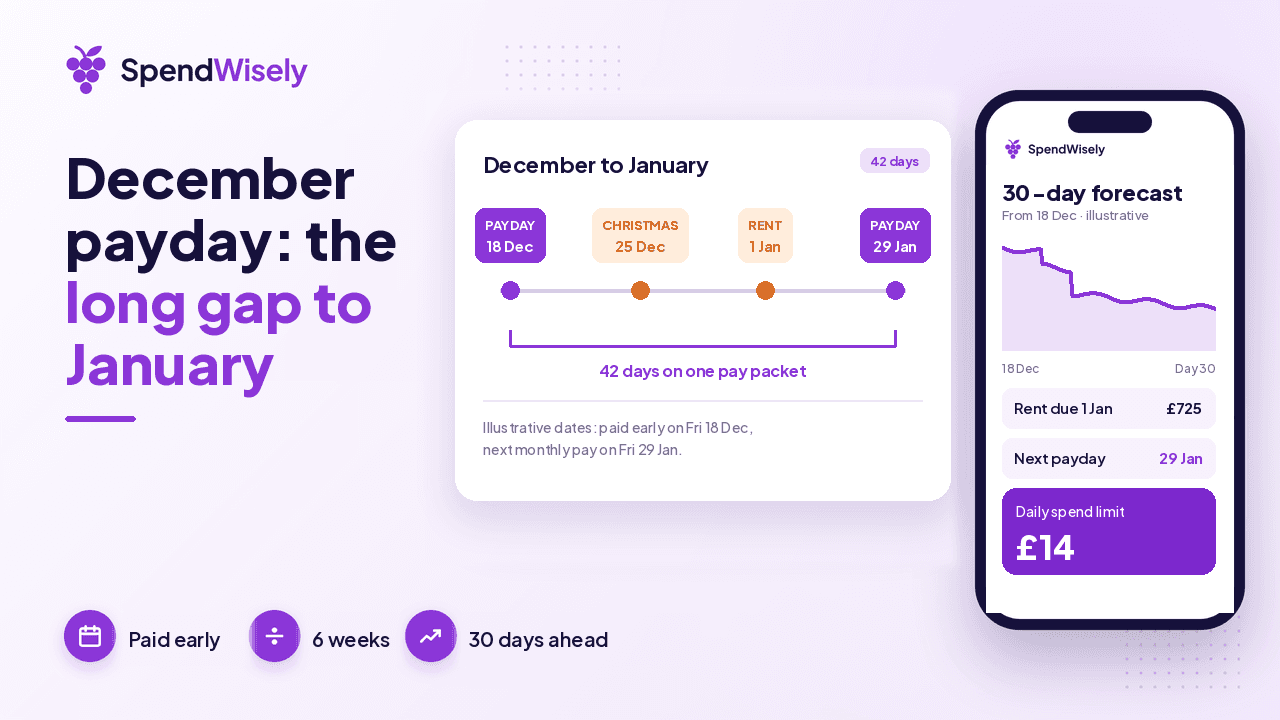
Short answer: many employers pay December wages early, often the week before Christmas. That is not extra money. It is your normal December pay arriving sooner, and it usually has to last until your normal January payday at the end of January, which can be five to six weeks away. Plan it as one long pay period: take out rent and every bill due before January payday first, then divide what is left by the number of days until you are next paid.
This is educational money-management information from SpendWisely (Adleads Ltd). It is not personalised financial advice or benefits advice, and Adleads Ltd is not authorised by the FCA. If you are struggling with debt, contact StepChange, National Debtline, or MoneyHelper.
Why December pay comes early
Payroll teams often close over Christmas, and bank holidays fall right where some paydays would be. In 2026, Christmas Day is a Friday, the Boxing Day bank holiday moves to Monday 28 December, and New Year's Day 2027 is also a Friday. So employers who normally pay at the end of the month often pay a week or more early, around 18 December.
Your January pay usually goes back to its normal date. If that is the last Friday or last working day of the month, it is Friday 29 January 2027.
| Illustrative dates | Date |
|---|---|
| Early December payday | Friday 18 December 2026 |
| Christmas Day | Friday 25 December 2026 |
| Rent due | Friday 1 January 2027 |
| Normal January payday | Friday 29 January 2027 |
| Days between paydays | 42 (six weeks) |
Check your own dates with payroll. These are examples only.
What December pay has to cover
That one payslip usually has to pay for:
- Christmas and New Year: food, presents, travel and nights out.
- Rent or mortgage due on or around 1 January.
- Every bill and direct debit due before January payday, including energy, phone and subscriptions.
- BNPL instalments from Black Friday or Christmas shopping that start in January.
- Council tax: January is the last instalment on the usual 10-month plan, then February and March are payment-free. See what months council tax is not paid.
The trap is treating it like a normal month. The balance on 18 December looks like a full month's pay, but it has to stretch about 11 days further than usual.
Worked example: monthly pay (illustrative)
Take-home pay of £2,000, paid early on 18 December. Figures for illustration only.
| Before 29 January | Amount |
|---|---|
| Rent (1 January) | £725 |
| Other bills and direct debits | £400 |
| Christmas budget | £300 |
| Left for day-to-day spending | £575 |
- £575 ÷ 42 days = about £14 a day until 29 January.
- If you budget it as a normal 31-day month, you would spend about £18.55 a day and run out around 18 January, 11 days before payday.
If you're paid weekly
Weekly-paid workers don't get a six-week gap, but Christmas still moves paydays. In 2026 both Christmas Day and New Year's Day fall on a Friday, so a Friday payday is often brought forward, for example to Thursday 24 December and Thursday 31 December. Ask your employer what they plan to do.
The risk is the pay that lands on 31 December. It is really your first January pay, and it arrives on New Year's Eve, right before rent on the 1st. Park the rent share before you go out. If January only has four paydays left after that, it can feel short. The five-payday month guide explains why the count matters, and how to make weekly wages last covers the daily spend limit.
If you're paid fortnightly
It depends on where your cycle falls. If a fortnightly payday lands on 25 December or 1 January, it will probably be paid a day or more early, so the next gap is longer than 14 days. Count the real days to your next payslip and divide by that, not by 14. See which fortnightly payslip covers which bill.
Paid early and on Universal Credit?
If an early December wage lands in the same Universal Credit assessment period as another wage, your award for that period can drop. HMRC asks employers to report your normal contractual payday even when they pay early at Christmas, which helps avoid this. If your statement looks wrong, report it in your journal. GOV.UK explains how earnings affect Universal Credit.
How to plan the stretch, step by step
- Confirm both dates: when your December pay lands and when January pay lands.
- Count the days between them. It is often 40 or more.
- List everything due before January payday: rent, bills, BNPL, council tax and debt repayments.
- Move bill money out first into a separate pot on payday.
- Set a Christmas budget and take it out next.
- Divide what is left by the days to January payday. That is your daily spend limit.
- Check again after Christmas. If you are over, cut back now rather than in the last week of January.
For more on why the money goes faster than expected, see how to stop overspending between paydays.
A short no-spend challenge in early January protects the longest gap of the year. There's a free printable.
Plan it with a 30-day forecast
A bank balance only shows today. A 30-day cashflow forecast shows your balance day by day against every bill and payday ahead, so you can see whether 18 December's pay reaches rent on the 1st and the bills after it.
In SpendWisely, the AI Guide sets up your balance, pay and bills with you in a chat. On 18 December the forecast runs to mid-January, so rent and early-January bills are in view. Refresh your balance after Christmas and the 30-day window moves on to cover January payday. There is no Open Banking or bank login: you update the balance yourself when pay lands.
Frequently asked questions
Why do we get paid early in December?
Many employers close over Christmas, and bank holidays can fall on normal paydays, so they pay December wages early, often in the week before Christmas.
Is early December pay extra money?
No. It is your normal December wage paid sooner. Your next pay is usually your normal January payday, so the same money has to last longer.
How long is the gap to January payday?
It is often five to six weeks. For example (illustrative), paid on 18 December 2026 with the next payday on 29 January 2027 is 42 days.
How do I make my December pay last until January?
Take out rent and every bill due before January payday first, set a Christmas budget, then divide what is left by the days until January payday to get a daily spend limit.
Do weekly-paid workers get paid early at Christmas?
Often, when payday falls on a bank holiday. In 2026 Christmas Day and New Year's Day are both Fridays, so Friday paydays may move to the Thursday before. Check with your employer.
Does being paid early in December affect Universal Credit?
It can, if two wages fall in one assessment period. Employers are told to report your normal payday to HMRC to avoid this. If your award looks wrong, report it in your Universal Credit journal.
Do I need to connect my bank to use SpendWisely?
No. SpendWisely is a 30-day forecast. No bank login needed: the AI Guide sets up your 30-day forecast from a few quick questions in chat, and you just refresh your balance when pay lands. There is no Open Banking.
Start a 14-day trial
See whether December's pay reaches January, with rent, bills and a daily spend limit on one 30-day forecast. Get started free — 14-day free trial. No bank connection or Open Banking login. No payment card required. Cancel at any time. After the trial, Premium is £8.75 a month or £63 a year.
Related: Stop overspending between paydays · Make weekly wages last · Five-payday months · Bills if paid fortnightly · What months is council tax not paid · Why am I always broke after payday? · No-spend challenge
Read more
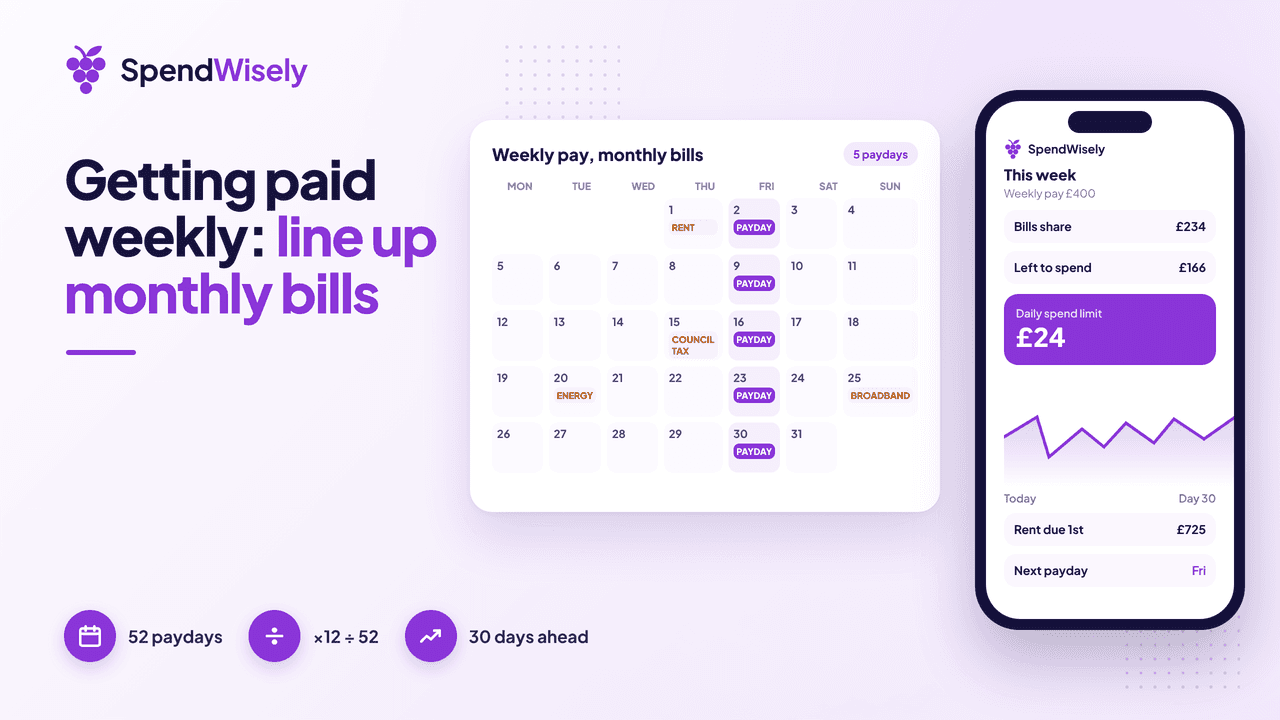
Getting paid weekly: pros, cons, and how to line up monthly bills
Getting paid weekly: the real pros and cons, weekly vs monthly pay, and how to line up rent and monthly bills with ×12÷52 and a 30-day forecast.
Weekly pay bill calendar: turn monthly bills into weekly amounts
Paid weekly? Turn rent, council tax and BNPL into a weekly amount (÷ 4.33), see which Friday each bill hits, and stop the weekend clearance surprise.
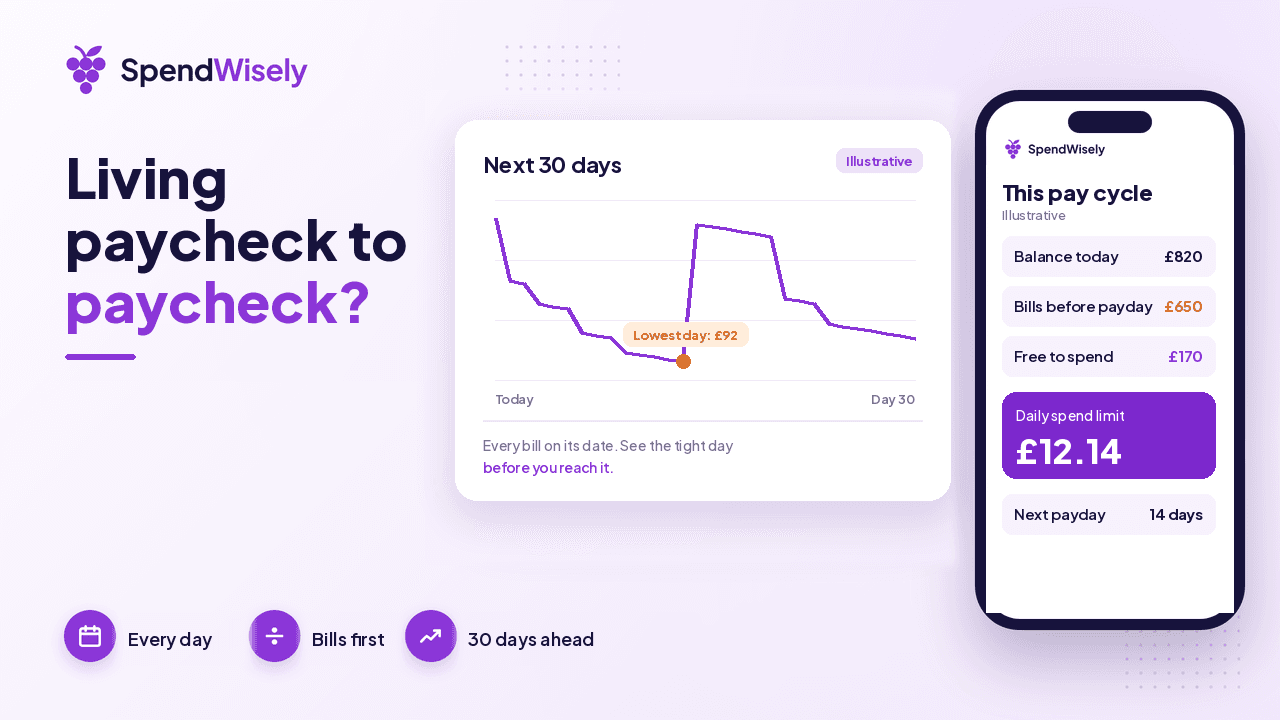
Living paycheck to paycheck: what it means and how to break the cycle
Living paycheck to paycheck means your pay runs out before the next one lands. The signs, why it happens on a decent wage, and how a 30-day forecast breaks the cycle.