Getting paid weekly in the UK: pros, cons, and how to line up monthly bills
Getting paid weekly in the UK: the real pros and cons, weekly vs monthly pay, and how to line up rent and monthly bills with ×12÷52 and a 30-day forecast.
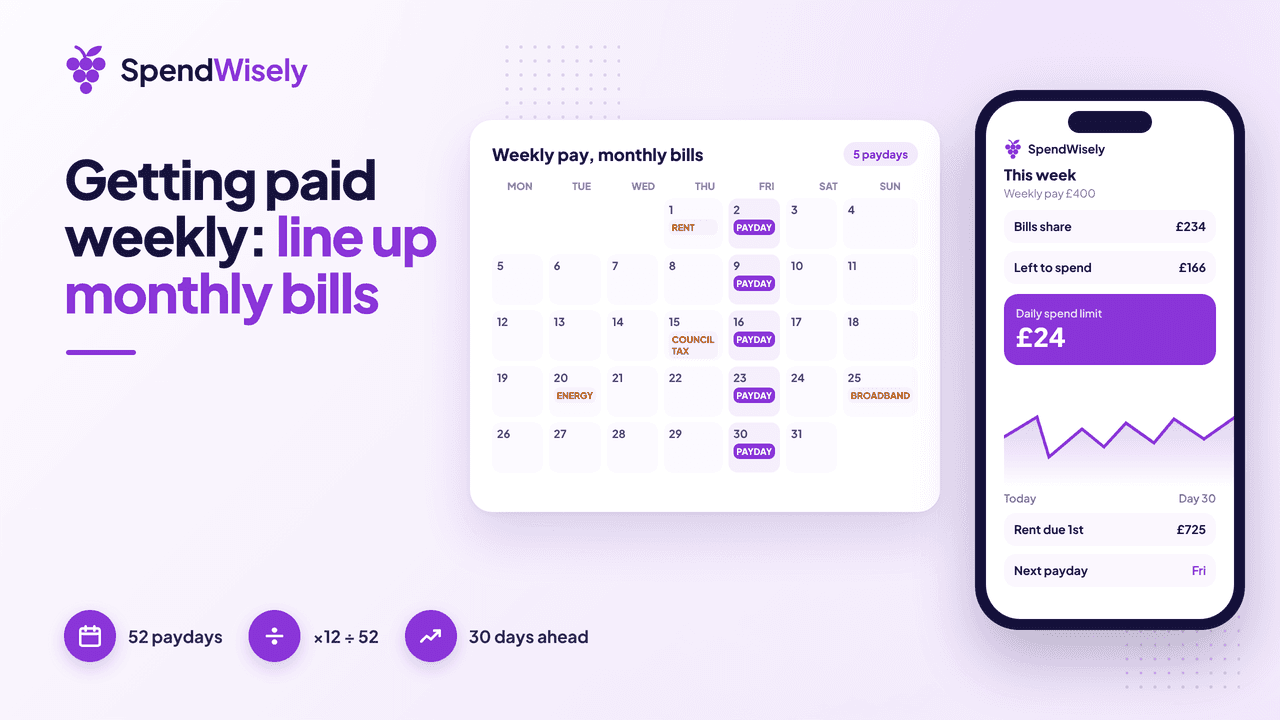
Getting paid weekly means money arrives 52 times a year (occasionally 53), so you are never more than seven days from pay, but your rent and most bills still leave monthly. The fix is to set aside each bill’s weekly share from every packet (monthly × 12 ÷ 52, about ÷ 4.33) and look 30 days ahead so bill dates never catch you out.
This is educational money-management information from SpendWisely (Adleads Ltd). It is not personalised financial advice, benefits advice, or employment-law advice, and Adleads Ltd is not authorised by the FCA. If you are in debt crisis, contact StepChange, National Debtline, or MoneyHelper. If money worry is affecting how you feel, Mind has guidance on getting support.
What getting paid weekly looks like in the UK
Weekly pay is common in hospitality, retail, warehousing, care, construction, and agency work. You usually get a payslip each week showing your hours, any overtime, tax, and National Insurance.
Many weekly-paid jobs pay a week in arrears (sometimes called “a week in hand”). That means the first packet of a new job can arrive a week or more after you start. Check your contract or ask payroll so the first month does not surprise you.
The pros of getting paid weekly
- Short wait for money. The longest you go without pay is seven days, not a month.
- Easier to check your pay. Hours and overtime show up on the next payslip, so mistakes are quicker to spot and fix.
- Smaller, more frequent decisions. A bad week costs you one week, not a whole month.
- Five-payday months can build a buffer. If you park the extra packet rather than spend it, those months quietly fund the rest of the year.
The cons of getting paid weekly
- Monthly bills do not line up. Rent, council tax, and energy leave monthly, so some weeks carry big bills and others carry none.
- Four or five paydays a month. Income per calendar month is uneven even when your wage is steady.
- Payday feels rich every Friday. A fresh balance every week makes it easy to spend money that next week’s bills need. That is how overspending between paydays starts. See how to stop overspending between paydays.
- Benefits can swing. Universal Credit is worked out over monthly assessment periods, so a period with five weekly paydays can mean a lower payment that month. GOV.UK explains how it is calculated.
Weekly pay vs monthly pay
For the same yearly wage, weekly and monthly pay add up to the same total over a year. What changes is timing.
| Weekly pay | Monthly pay | |
|---|---|---|
| Paydays a year | 52 (occasionally 53) | 12 |
| Longest gap between pays | 7 days | Up to about 31 days |
| Paydays per calendar month | 4 or 5 | 1 |
| Monthly bills | Need converting (×12 ÷ 52) | Usually line up with payday |
| Main risk | Spending Friday’s balance before bills | The long last week before payday |
Neither is “better”. Weekly pay suits people who like short horizons, as long as monthly bills are converted honestly. Four weekly pays is not a month: 52 ÷ 12 = 4.33. Budget with ×4 and you fall short by about four weeks of bills a year, which is why five-payday months feel like a bonus when they are really catch-up.
How to line up monthly bills on weekly pay
- List every monthly bill with its due date. Rent, council tax, energy, phone, broadband, insurance, subscriptions, and any BNPL instalments.
- Convert each one to a weekly share. Monthly amount × 12 ÷ 52 (about ÷ 4.33). Annual costs: yearly total ÷ 52.
- Move the weekly share out every payday, before you spend anything else. A separate pot or account helps.
- Build a starter buffer. The converter works over a year, but rent can leave before you have saved four shares. Use a five-payday month or overtime to get ahead by one bill cycle.
- Ask about due dates. Some providers let you pick your Direct Debit date, and many councils let you spread council tax over 12 months instead of 10. Ask yours.
- Set a daily spend limit on what is left until the next payday, and check the next 30 days for bill-heavy weeks.
For the full method, see our guide on how to budget when you get paid weekly, and the step-by-step post on budgeting on weekly pay.
Worked example (illustrative)
Weekly take-home: £400 (about £1,733 a month on average: £400 × 52 ÷ 12). Figures for illustration only.
| Bill | Monthly | Due | Weekly share (×12 ÷ 52) |
|---|---|---|---|
| Rent | £725 | 1st | £167 |
| Council tax | £140 | 15th | £32 |
| Energy | £95 | 20th | £22 |
| Phone and broadband | £55 | 25th | £13 |
| Total | £1,015 | £234 |
- Weekly take-home £400 − bill share £234 = £166 left
- Days to next payday: 7
- Daily spend limit ≈ £24
Notice that rent (£725) leaves on the 1st, but you only park £167 a week towards it. That is why step 4 matters: until you are one cycle ahead, the week rent leaves is the tight one. A 30-day forecast shows that week coming before you reach it.
Frequently asked questions
Is getting paid weekly better than monthly?
Neither is better. For the same yearly wage the total is the same. Weekly pay gives shorter gaps between pays but needs monthly bills converted with ×12 ÷ 52.
How do I budget when I get paid weekly?
Convert each monthly bill to a weekly share (monthly × 12 ÷ 52), move that out every payday, then set a daily spend limit on what is left until the next payday. Check 30 days ahead for bill-heavy weeks.
Why do some months have five weekly paydays?
A year has 52 weeks, which is about 4.33 per month. Most months have four paydays and some have five. The fifth packet is catch-up for four-payday months, not spare money.
How do I pay monthly rent on weekly pay?
Park the weekly share of rent (monthly rent × 12 ÷ 52) every payday and build a starter buffer so the full rent is ready on its due date.
Do I need to connect my bank to use SpendWisely?
No. SpendWisely is a 30-day forecast from the balance, pay, and commitments you enter. The AI Guide can set these up with you in a chat, and you refresh the balance when pay lands. There is no Open Banking or bank login.
Start a 14-day trial
Put weekly paydays and monthly bill dates on one 30-day forecast, with a daily spend limit. Get started free — 14-day free trial. No bank connection or Open Banking login. No payment card required. Cancel at any time. After the trial, Premium is £8.75 a month or £63 a year.
Related: Weekly pay guide · Budgeting on weekly pay · Five-payday months · Make weekly wages last · Zero-hours floor week · Weekend balances
Read more

How to budget if you’re paid weekly in the UK
How to budget weekly pay in the UK: convert bills with 4.33, set a daily spend limit between paydays, and forecast 30 days ahead — no bank connection.
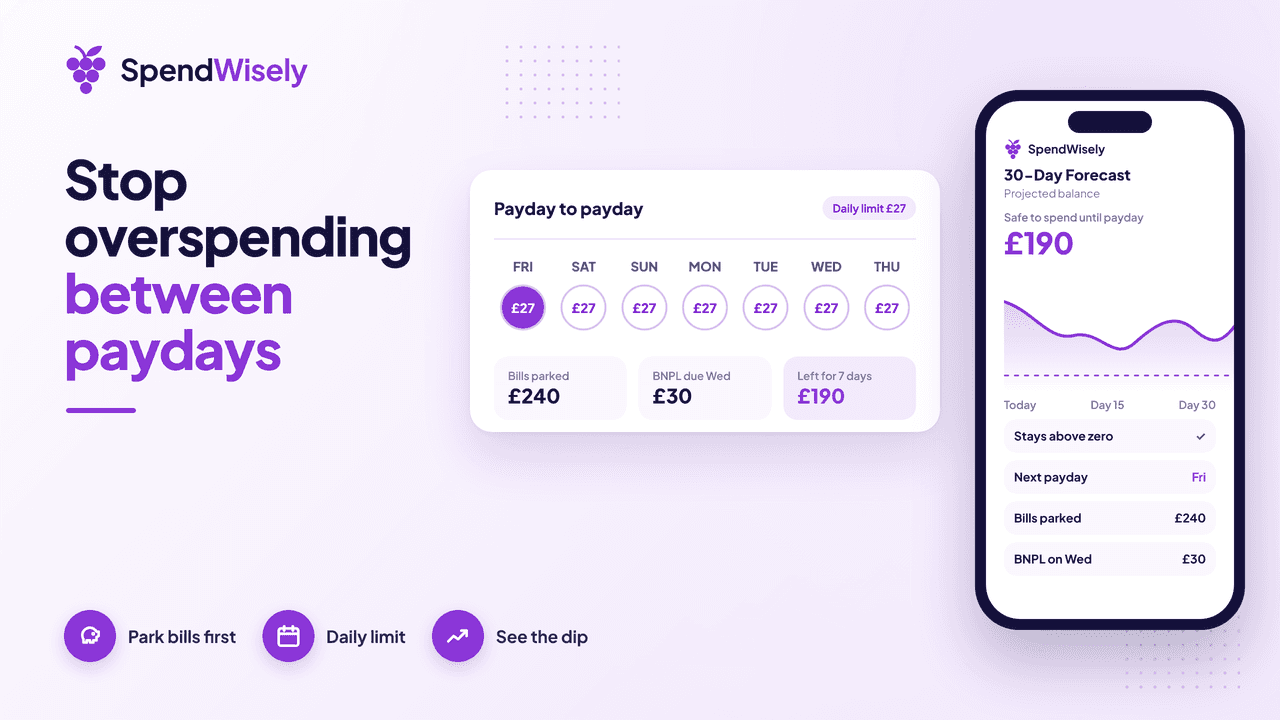
How to stop overspending between paydays: 7 fixes for weekly or fortnightly pay
How to stop overspending between paydays in the UK: park bill money first, set a daily spend limit, plan for BNPL and weekends, and check 30 days ahead.
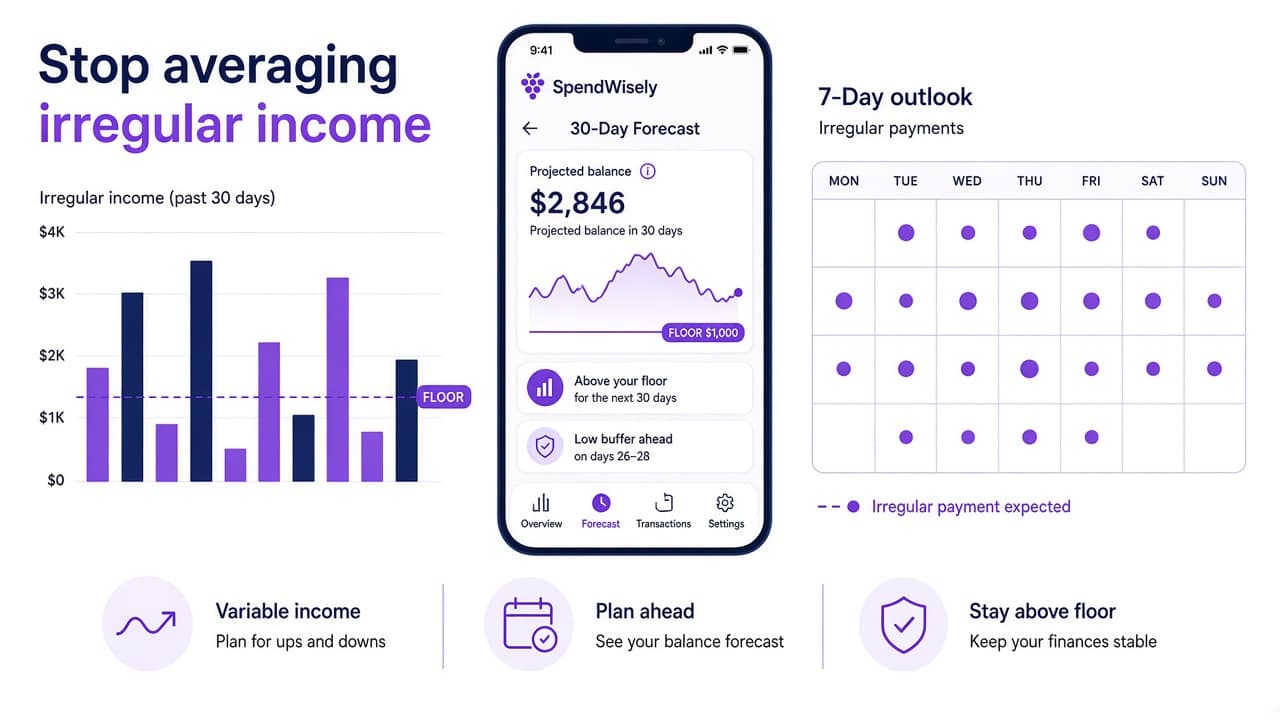
Irregular income UK: stop budgeting from the average week
Irregular income in the UK fails when you average the good weeks. Budget from a floor, forecast 30 days of lumpy pay, and stop overspending the spike — no bank connection.