Impulse spending and ADHD: how to stop overspending when “now” wins
Impulse spending with ADHD isn't about not caring. “Now” feels louder than rent in nine days. Practical, shame-free ways to stop impulse buying by making “later” visible.
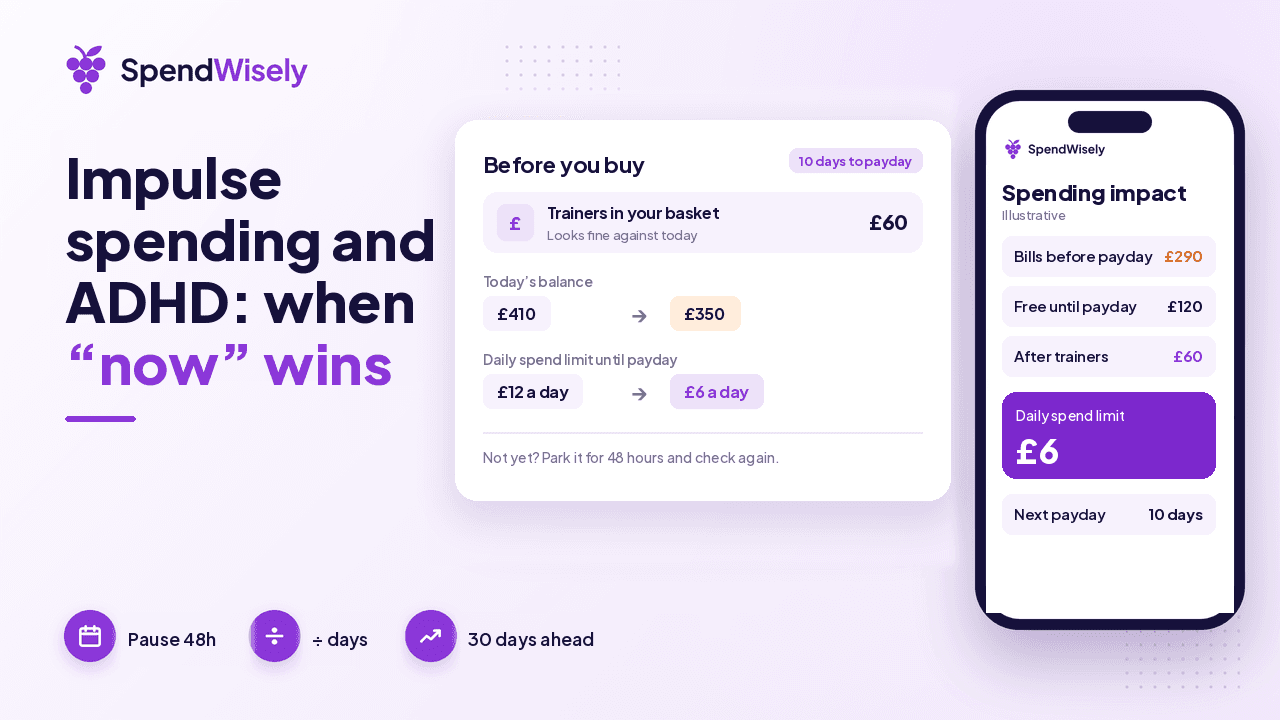
Short answer: if you have ADHD, impulse spending usually isn't about not caring about money. Many people with ADHD describe "now" feeling much louder than "later": the thing in the basket is vivid, while rent in nine days is invisible. That's why willpower-only plans tend to fail. What helps is making "later" visible at the moment you buy, adding a short pause, and removing the shortcuts between the urge and the checkout.
This is general money-management information from SpendWisely (Adleads Ltd). It is not medical, psychological or personalised financial advice, and Adleads Ltd is not authorised by the FCA. For information and support about ADHD, see ADHD UK, Mind or the NHS guide to ADHD in adults, and speak to your GP if you think you may have ADHD. If you are struggling with debt, contact StepChange, National Debtline, or MoneyHelper.
Is overspending a symptom of ADHD?
Overspending isn't a diagnosis or a symptom on its own, and plenty of people overspend without ADHD. But Mind and the NHS both list things like making impulsive decisions and finding it hard to estimate and manage time among common ADHD experiences. It's easy to see how those can show up at a checkout. Only a qualified professional can assess ADHD, so if this sounds familiar, start with your GP.
Whatever the cause, the practical fixes below are the same, and none of them rely on feeling guilty.
How to stop spending money with ADHD
To stop spending money with ADHD, make the pause automatic instead of relying on willpower. Know one daily spend limit, check each purchase against the next 30 days, park non-essentials for 48 hours, and remove saved cards. Set it up once, on a good day, so it works on a bad one.
A quick checklist:
- Bill money moved to a separate pot on payday
- One daily spend limit you can see at a glance
- Saved cards removed from the apps you overspend in
- Sale emails and shopping notifications turned off
- A 48-hour parking list for anything that isn't essential
- A small, guilt-free fun money amount each week
- One person you message before any purchase over a set amount
The detail behind each one is below.
Why "now" wins
Three things make impulse buying hard to resist, and they hit harder when focus and time feel slippery:
- The purchase is right in front of you. Pictures, a countdown timer, "only 2 left".
- The cost is invisible. Today's balance doesn't show the bills due before payday, so £60 looks like nothing against £410.
- Checkout is instant. Saved cards, one-tap pay and buy now, pay later take the friction away.
The answer isn't to try harder. It's to change what you can see and how many steps it takes.
How to stop impulse buying with ADHD: 9 practical fixes
- Know your daily number. One figure, what's safe to spend per day until payday, is easier to hold in your head than a budget with 20 categories.
- Check before you buy, not after. Look at what the purchase does to the next 30 days, not just today's balance. See the dip before you buy.
- Use a parking list. Instead of "no", say "not yet". Add it to a note and look again in 48 hours. Many urges fade on their own.
- Move bill money out on payday. If rent and bills are in a separate pot, the money you see is the money you can spend.
- Remove saved cards from shopping sites and apps you overspend on.
- Turn off sale emails and app notifications. Fewer prompts, fewer impulses.
- Be careful with buy now, pay later. It splits the cost into smaller instalments that are easy to lose track of. If you use it, add every instalment to your plan.
- Give yourself fun money. A small weekly amount that's yours to spend, guilt-free, makes the plan easier to stick to.
- Ask someone to be your pause. A friend or partner you message before any purchase over a set amount.
You don't need all nine. Pick two that remove the most friction for you and start there.
The 48-hour rule and the other steps are in how to stop spending money.
How to stop the urge to spend
The urge usually peaks and passes. A few things can help you ride it out:
- Name it. "I want this because I'm bored, tired or stressed" takes some of the heat out of it.
- Change the scene. Close the app or put the phone down for ten minutes.
- Ask one question: "What does this do to my daily number until payday?"
If spending is tied to your mood, or feels out of control, Mind has guidance on money and mental health. Talking to your GP is a good step too.
Worked example (illustrative)
It's Tuesday and payday is ten days away. Figures for illustration only.
| Amount | |
|---|---|
| Balance today | £410 |
| Bills due before payday (phone, BNPL, energy) | £290 |
| Free to spend until payday | £120 |
| Daily spend limit | £12 a day |
A £60 pair of trainers looks fine against £410. Against the next ten days, it halves your daily limit from £12 to £6. Seeing that before you tap "buy" is often enough to park it for 48 hours.
What doesn't help
- Shame. Calling yourself "terrible with money" makes it harder to look at your balance at all. See why being bad with money is usually a timing problem.
- Complicated budgets. Lots of categories and daily tracking often get abandoned after a week.
- All-or-nothing bans. A strict no-spend rule with no fun money tends to end in a bigger spend.
How a 30-day forecast helps
A 30-day cashflow forecast puts "later" on the screen next to "now". It shows your balance day by day with every bill and payday, and a daily spend limit you can check in seconds. In SpendWisely, the AI Guide sets up your balance, pay and bills with you in a chat, so there's no long setup. You refresh your balance when pay lands. There's no Open Banking or bank login. SpendWisely is a money tool, not a treatment for ADHD.
Frequently asked questions
Is overspending a symptom of ADHD?
Overspending isn't a symptom or diagnosis on its own. But impulsive decisions and difficulty managing time, which are common ADHD experiences, can make impulse buying more likely. Only a qualified professional can assess ADHD.
Why do people with ADHD impulse buy?
Many people describe the purchase in front of them feeling much more real than bills due later. Instant checkout and buy now, pay later make it easy to act before thinking it through.
How do I stop spending money with ADHD?
Make the pause automatic: one daily spend limit, a 48-hour parking list, no saved cards and bill money moved out on payday. Set it up once so it works without willpower.
How do I stop impulse buying with ADHD?
Make "later" visible with a daily spend limit, check what a purchase does to the next 30 days, use a 48-hour parking list, remove saved cards and give yourself some guilt-free fun money.
How do I stop the urge to spend?
Name the feeling, step away for ten minutes and ask what the purchase does to your daily number until payday. If urges are tied to your mood, Mind has guidance on money and mental health.
Is impulse spending a mental disorder?
Impulse spending on its own isn't a diagnosis. If spending feels out of control or is affecting your wellbeing, talk to your GP or see Mind for support.
Do I need to connect my bank to use SpendWisely?
No. SpendWisely is a 30-day forecast. No bank login needed: the AI Guide sets up your 30-day forecast from a few quick questions in chat, and you just refresh your balance when pay lands. There is no Open Banking.
Start a 14-day trial
See what a purchase does to the next 30 days before you buy, with one daily number to check. Get started free — 14-day free trial. No bank connection or Open Banking login. No payment card required. Cancel at any time. After the trial, Premium is £8.75 a month or £63 a year.
Related: Why am I always broke after payday? · Bad with money? It's timing · See the dip before you buy · Stop overspending between paydays · Why you can’t control spending · How to stop spending money · No-spend challenge
Read more
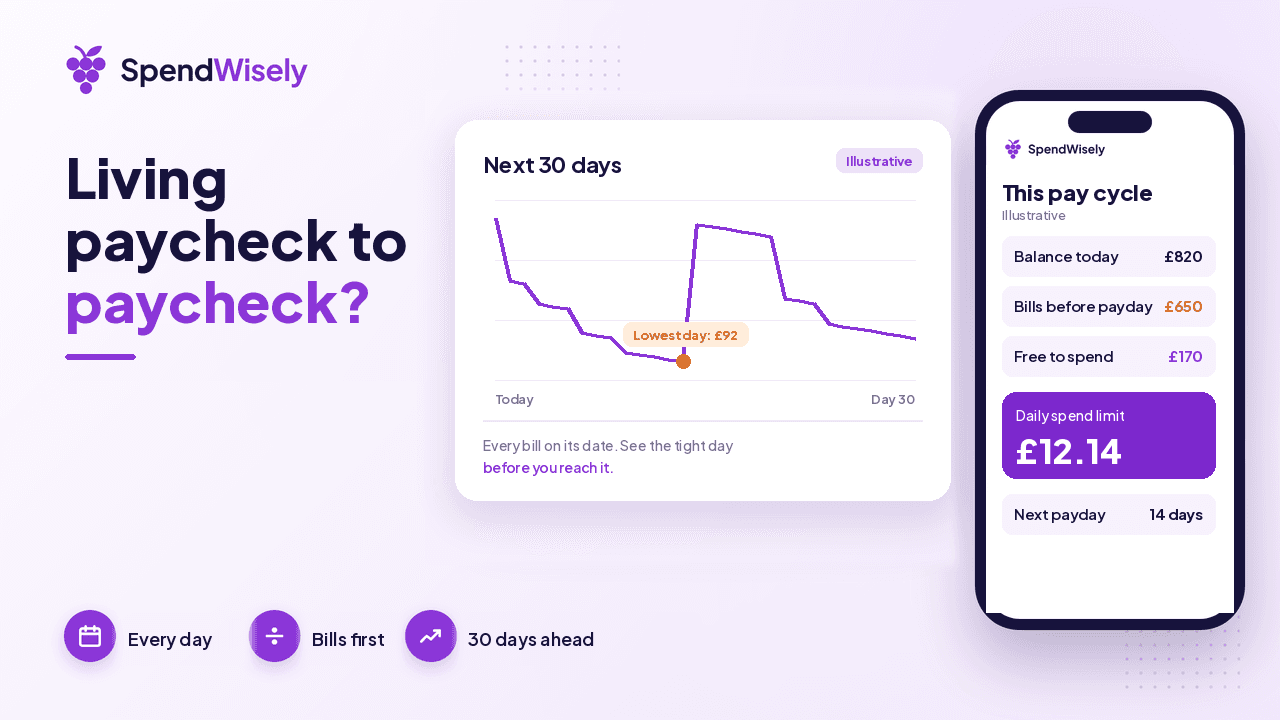
Living paycheck to paycheck: what it means and how to break the cycle
Living paycheck to paycheck means your pay runs out before the next one lands. The signs, why it happens on a decent wage, and how a 30-day forecast breaks the cycle.
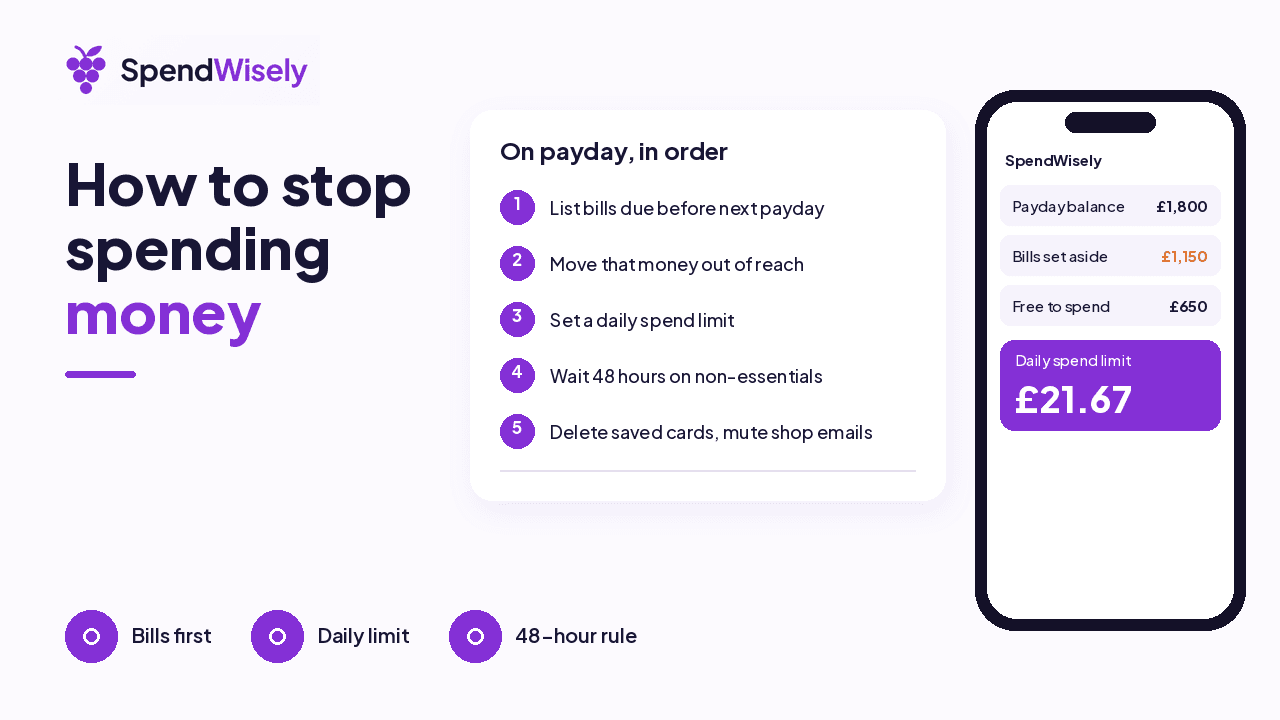
How to stop spending money: 9 steps that work between paydays
To stop spending money, move bills out on payday, set a daily spend limit, add a 48-hour pause and delete saved cards. Nine steps, no willpower needed.
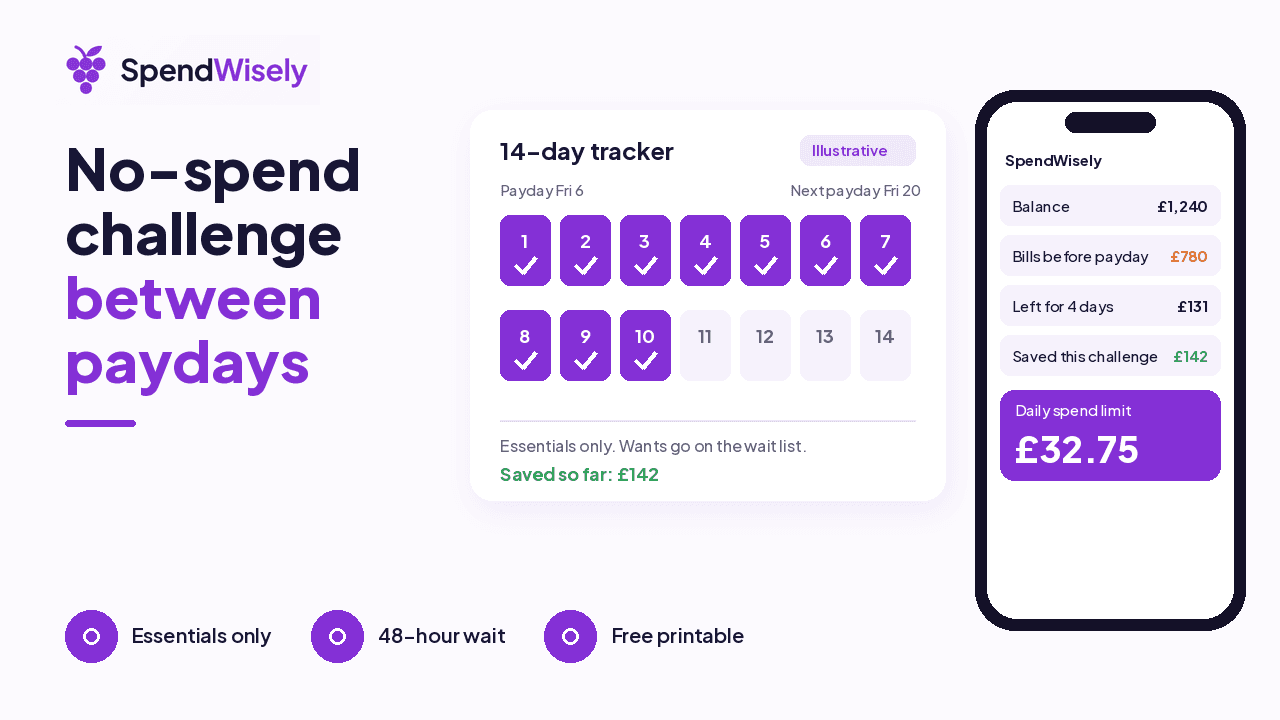
No-spend challenge: how to do one between paydays (free printable)
A no-spend challenge means buying only essentials for a set time. Simple rules, a 7, 14 or 30-day plan timed to your payday, and a free printable tracker.