Last updated: 1 November 2026
SpendWisely guide
Paid every 4 weeks vs monthly
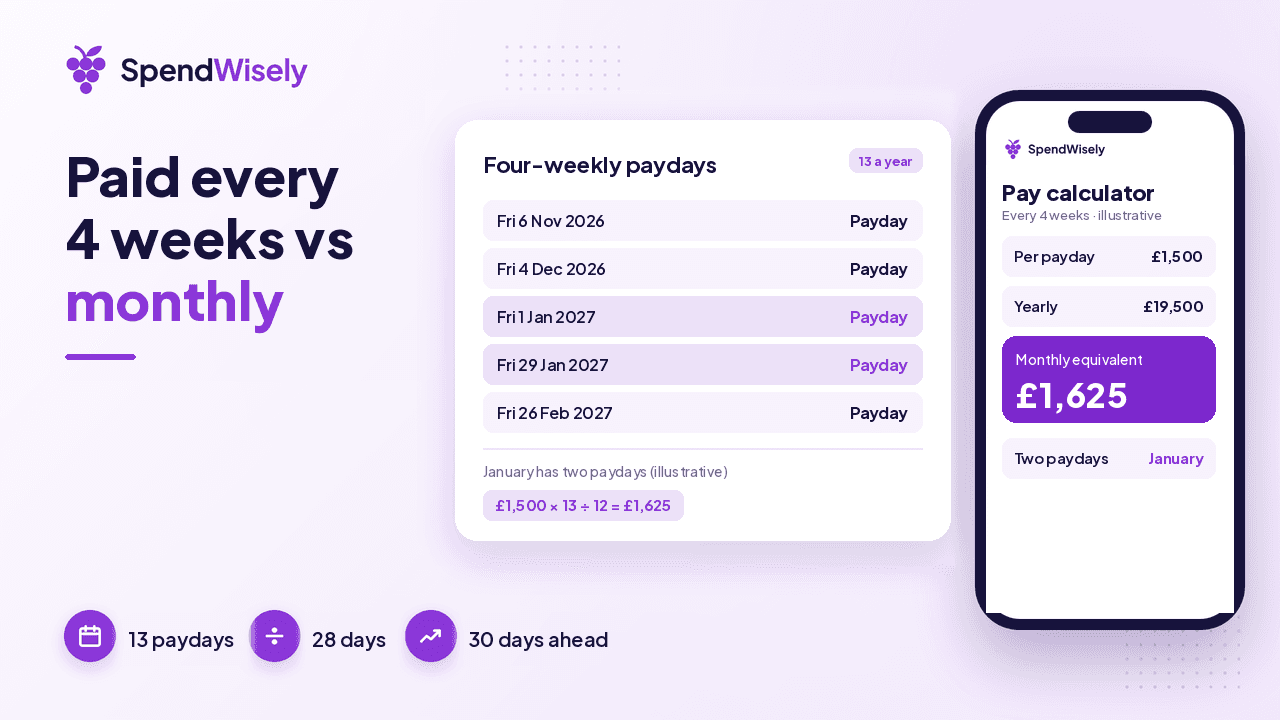
Paid every 4 weeks means 13 paydays a year instead of 12. Your yearly pay is the same, but each payday is a little smaller than a monthly salary, your payday moves earlier each month, and one month gets two paydays. Use the calculator below to see your monthly equivalent and which month has two.
Four-weekly pay calculator
Quick maths: monthly equivalent = one four-weekly payday × 13 ÷ 12. Going the other way, a monthly salary × 12 ÷ 13 gives the same yearly pay paid every four weeks.
This is educational money-management information from SpendWisely (Adleads Ltd). It is not personalised financial advice or benefits advice, and Adleads Ltd is not authorised by the FCA. If you are in debt crisis, contact StepChange, National Debtline, or MoneyHelper.
About 9.3% of employee jobs are paid every four weeks (ONS ASHE, April 2021).
Paid every 4 weeks vs monthly: the difference
| Every 4 weeks | Monthly | |
|---|---|---|
| Paydays a year | 13 | 12 |
| Payday date | Moves earlier each month | Same date each month |
| Gap between paydays | Always 28 days | 28 to 31 days |
| Each payday | Smaller (yearly ÷ 13) | Larger (yearly ÷ 12) |
| A month with two paydays | Yes, once a year | No |
Neither is better on pay: the yearly total is the same. Four-weekly pay is easier in short months and harder when monthly bills don't line up with your payday.
How four-weekly pay works
There are 52 weeks in a year, and 52 ÷ 4 = 13. Each payday is exactly 28 days after the last, so it lands on a different date each month and slowly drifts earlier through the year.
The month with two paydays
Once a year, two paydays land in the same calendar month. It feels like a bonus, but your monthly bills don't change. Many people set the second payday aside to cover the months where rent and bills come out before pay arrives.
Why monthly bills are awkward on four-weekly pay
Rent, council tax and most direct debits come out monthly, but your pay arrives every 28 days. Some pay periods cover two rent payments, others cover one. Seeing your balance for every day ahead shows which pay periods will be tight.
Benefits paid every 4 weeks
PIP is usually paid every four weeks, and Carer's Allowance weekly or every four weeks (DWP benefits statistics, August 2025). The same 13-payment pattern applies.
Related guides
Frequently asked questions
Is it better to be paid every 4 weeks or monthly?
Your yearly pay is the same. Four-weekly gives 13 smaller paydays and one month with two; monthly gives 12 larger paydays on a fixed date. Which suits you depends on when your bills fall.
How many paydays do you get if paid every 4 weeks?
13 a year, one every 28 days.
How do I work out 4-weekly pay as a monthly amount?
Multiply one payday by 13, then divide by 12. The calculator on this page does it for you.
Which month has two paydays?
It depends on your payday dates. Enter your next payday in the calculator to see it.
Is four-weekly the same as fortnightly?
No. Fortnightly is every two weeks, 26 paydays a year.
Start a 14-day trial
See your bank balance for every day of the month ahead, with a daily spend limit. Get started free — 14-day free trial. No bank connection or Open Banking login. No payment card required. Cancel at any time. After the trial, Premium is £8.75 a month or £63 a year.
Related: Weekly pay guide · Weekly vs monthly pay · Stop overspending · How it works
SpendWisely is not FCA-authorised and does not provide personalised financial advice. Forecasts are estimates based on the information you enter. If you are struggling with debt, free help is available from StepChange, National Debtline, and MoneyHelper.
Avoid overspending - free for 14 days
No bank login needed. The AI Guide sets up your forecast from a few quick questions in chat - then check it before you spend.
Start free trial