Irregular income budget template (UK): a simple spreadsheet plan
A free irregular income budget template for the UK: a simple spreadsheet that plans each month from a low floor, covers bills and a buffer, then the extra.
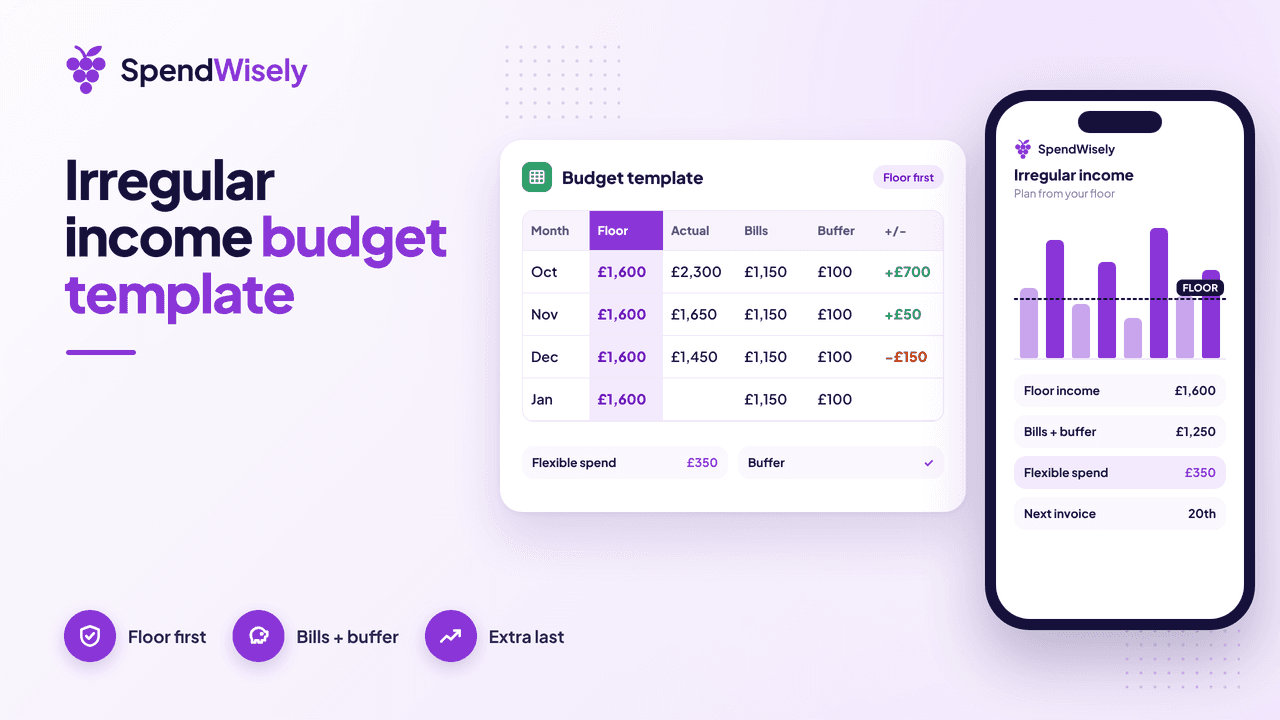
An irregular income budget template plans each month from a low floor income, not your average: bills and a buffer top-up come out of the floor, and only money above the floor goes on extras. Copy the simple spreadsheet below (or download the CSV), fill in one row each month, and update it whenever money actually lands.
This is educational money-management information from SpendWisely (Adleads Ltd). It is not personalised financial advice or tax advice, and Adleads Ltd is not authorised by the FCA. If you are in debt crisis, contact StepChange, National Debtline, or MoneyHelper. If money worry is affecting how you feel, Mind has guidance on getting support.
Who this template is for
Use it if your take-home changes month to month: self-employed or freelance work, commission or bonus-heavy pay, agency shifts, gig work, or a zero-hours contract.
Why the average fails is covered in irregular income: stop budgeting from the average week. This post is the practical part: a sheet you can fill in tonight.
The irregular income budget template
Seven columns, one row per month:
| Month | Floor income | Actual income | Bills & commitments | Buffer top-up | Flexible spend | Above / below floor |
|---|---|---|---|---|---|---|
| Month 1 | ||||||
| Month 2 | ||||||
| Month 3 |
How each column works:
- Floor income: a low take-home you can realistically expect. Look back over the last 6 to 12 months and pick a quiet month you have actually had.
- Actual income: what really landed. Fill this in as money arrives, not before.
- Bills & commitments: rent, council tax, energy, phone, insurance, subscriptions, BNPL instalments, and debt repayments for that month.
- Buffer top-up: a fixed amount you move to a separate pot every month.
- Flexible spend: Floor income − Bills & commitments − Buffer top-up. This is food, travel, and life. Spreadsheet formula:
=B2-D2-E2 - Above / below floor: Actual income − Floor income. Spreadsheet formula:
=C2-B2
Download the irregular income budget template (CSV). It opens in Excel, Google Sheets, or Numbers, with the two formulas already in place for 12 months.
If money lands weekly rather than monthly, use one row per week and convert monthly bills with × 12 ÷ 52 (about ÷ 4.33).
How to budget irregular income with the template
- Set your floor. Pick it from real past months, not hope. If you are unsure, go lower.
- List bills and commitments with their due dates, including BNPL.
- Check the floor covers them. If bills are bigger than the floor, that is the problem to solve first. Free help is available from the debt charities listed above.
- Choose a buffer top-up you can hit every month, even a small one. A first target could be one month of bills.
- Spend from the floor only. Your flexible spend is fixed by the floor, whatever the month turns out to be.
- Sort the “above floor” money when it lands: tax set-aside first if you are self-employed (see GOV.UK on Self Assessment), then the buffer, then goals or treats.
- Cover a below-floor month from the buffer, and trim flexible spend before anything else.
Worked example (illustrative)
Three months for a self-employed worker, figures for illustration only. Floor take-home £1,600, bills and commitments £1,150, buffer top-up £100.
| Month | Floor income | Actual income | Bills & commitments | Buffer top-up | Flexible spend | Above / below floor |
|---|---|---|---|---|---|---|
| October | £1,600 | £2,300 | £1,150 | £100 | £350 | +£700 |
| November | £1,600 | £1,650 | £1,150 | £100 | £350 | +£50 |
| December | £1,600 | £1,450 | £1,150 | £100 | £350 | −£150 |
- Flexible spend stays at £350 every month (about £11.50 a day over 30 days), whatever comes in.
- October’s +£700 is not a spending month. Tax set-aside first, then the buffer.
- December comes in £150 under the floor. The buffer built in October covers it, and nothing on the bills line is missed.
Spend October like it was normal and December becomes an overdraft month. That is overspending on irregular income: it happens in the good month, not the bad one.
Where the template stops and a forecast helps
A monthly sheet shows how much. It does not show when. An invoice that clears on the 20th does not help with rent on the 1st.
SpendWisely is a 30-day cashflow forecast that puts real pay dates and bill dates on one timeline. The AI Guide can set up your balance, pay, and commitments (including BNPL) with you in a chat, and you refresh the balance when money lands. No Open Banking, no bank login. Before a bigger buy after a good month, Spending Impact shows the dip through the next quiet patch.
On a rota rather than invoices? See zero-hours and weekly pay: budget from a floor week.
Frequently asked questions
What is the best budget template for irregular income?
A simple one built on a floor: a low income you can realistically expect. Bills and a buffer top-up come out of the floor, and only money above the floor goes on extras.
How do I budget irregular income?
Pick a floor from past months, cover bills and a buffer top-up from it, spend only what is left, and sort above-floor money when it actually lands: tax set-aside first if self-employed, then buffer, then extras.
How do I choose my floor income?
Look at the last 6 to 12 months of take-home and pick a quiet month you have actually had. If in doubt, go lower. Raise it only when your income pattern has genuinely changed.
What should I do in a month below the floor?
Cover the gap from your buffer and trim flexible spend first. Keep bills and commitments on time. If that keeps happening, your floor is too high.
Do I need to connect my bank to use SpendWisely?
No. SpendWisely forecasts from the balance, pay, and commitments you enter. There is no Open Banking or bank login.
Start a 14-day trial
Put lumpy pay dates and bill dates on one 30-day forecast, with a daily spend limit from your floor. Get started free — 14-day free trial. No bank connection or Open Banking login. No payment card required. Cancel at any time. After the trial, Premium is £8.75 a month or £63 a year.
Related: Irregular income: stop averaging · Zero-hours floor week · Weekly pay guide · Stop overspending between paydays · Spending Impact · SpendWisely 30-day forecast
Read more
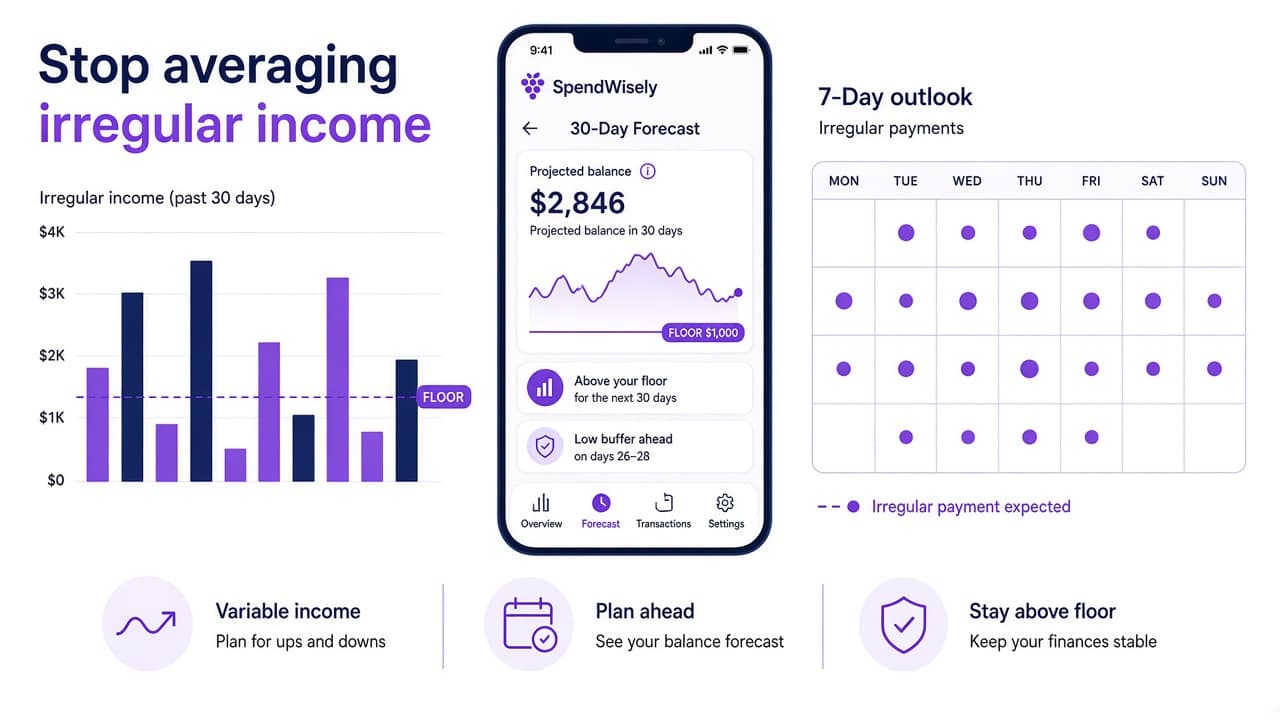
Irregular income UK: stop budgeting from the average week
Irregular income in the UK fails when you average the good weeks. Budget from a floor, forecast 30 days of lumpy pay, and stop overspending the spike — no bank connection.
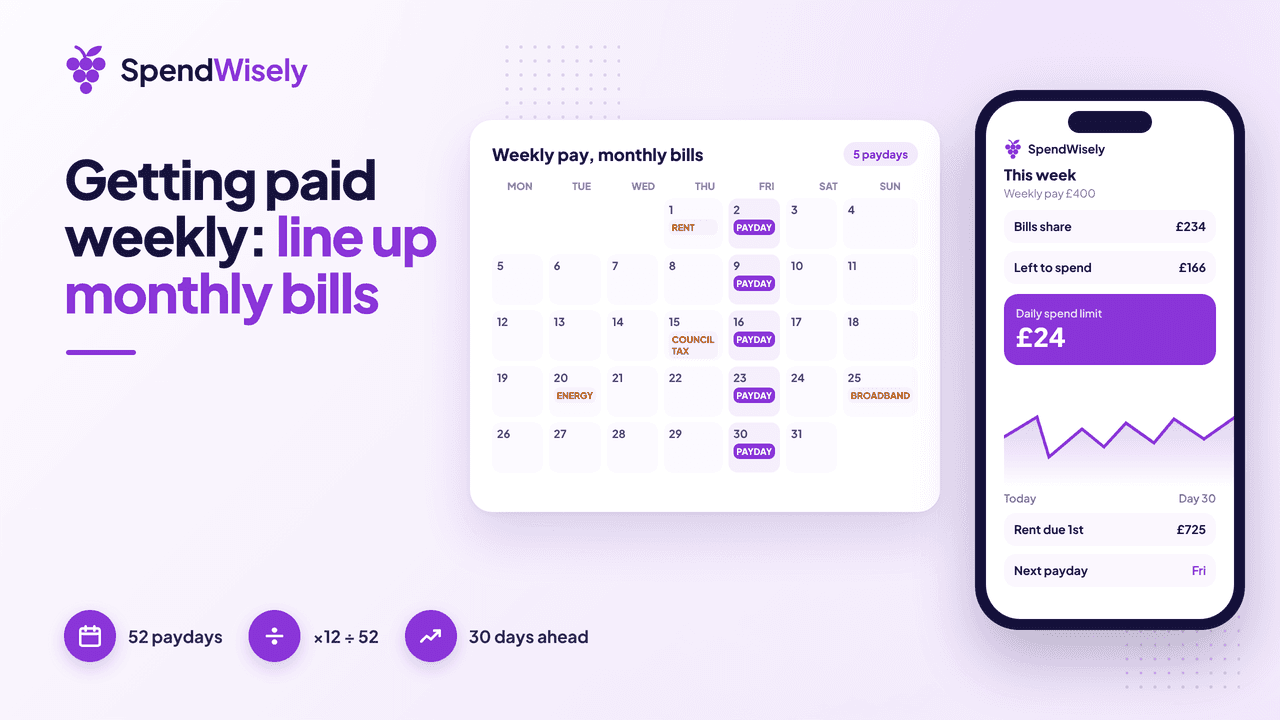
Getting paid weekly in the UK: pros, cons, and how to line up monthly bills
Getting paid weekly in the UK: the real pros and cons, weekly vs monthly pay, and how to line up rent and monthly bills with ×12÷52 and a 30-day forecast.
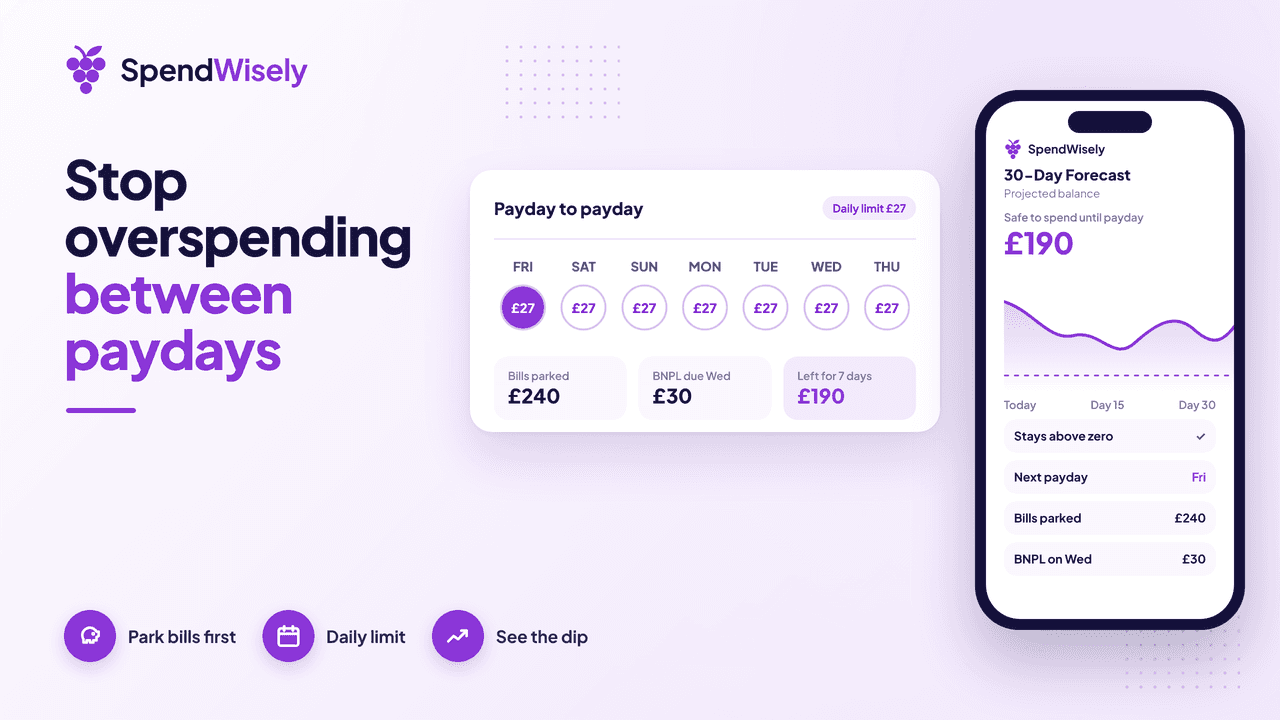
How to stop overspending between paydays: 7 fixes for weekly or fortnightly pay
How to stop overspending between paydays in the UK: park bill money first, set a daily spend limit, plan for BNPL and weekends, and check 30 days ahead.