Biweekly budget: how to budget a biweekly paycheck, step by step
How to budget a biweekly paycheck in 7 steps: list bills by due date, split them between check 1 and check 2, set a daily limit and plan 3 paycheck months.
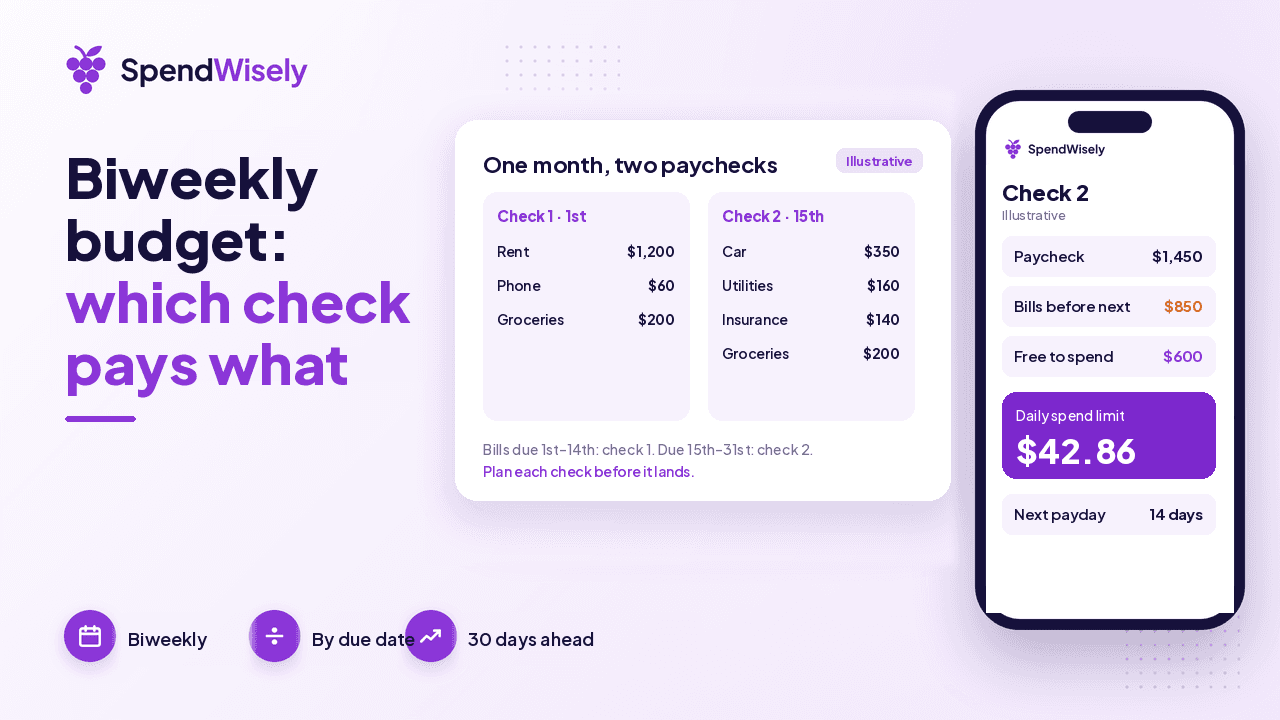
To budget a biweekly paycheck, list every bill by due date, then give each bill to the paycheck that lands before it. Bills due between your first and second payday come from check 1; the rest come from check 2. Split the largest bill, usually rent, across both checks. Whatever's left on each check, divided by 14, is your daily spend limit.
This is educational money-management information from SpendWisely (Adleads Ltd). It is not personalized financial advice, and Adleads Ltd is not authorized by the FCA (the British financial regulator). If you're struggling with debt in the US, the National Foundation for Credit Counseling (NFCC) can connect you with a nonprofit credit counselor. In Britain, contact StepChange, National Debtline, or MoneyHelper.
Why a monthly budget doesn't fit biweekly pay
Biweekly means you're paid every two weeks: 26 checks a year. Most bills are monthly. If you plan the month as one pot, the first two weeks often look rich and the last few days before rent look empty, because the money and the bills don't arrive together.
A biweekly budget plans each paycheck on its own. Every check has a job before it lands.
How to budget a biweekly paycheck in 7 steps
1. Write down your take-home pay per check
Use the amount that lands in your account after tax, health insurance and retirement contributions. If it varies, use your lowest recent check.
2. List every bill with its due date
Rent or mortgage, car payment, insurance, utilities, phone, internet, subscriptions, debt payments, child care and any buy now, pay later instalments. Write the day of the month each one is due.
3. Assign each bill to a paycheck
Use this rule: a bill is paid by the last paycheck that lands before its due date.
- Bills due after check 1 and before check 2 come from check 1.
- Bills due after check 2 and before next month's first check come from check 2.
If your paydays move around the month, plan by date, not by "first" and "second" check. A 30-day view makes this much easier.
4. Split the big bill
Rent is often due on the 1st and is too big for one check. Put half aside from each check in the month before it's due. That keeps the two checks roughly even.
5. Budget the variable costs per check
Groceries, gas and everyday spending happen every week, so give each check the same amount for these. Two weeks of groceries per check is easier than a monthly total.
6. Turn what's left into a daily limit
Take each check, subtract its bills and its share of variable costs, and divide by 14. That's your daily spend limit until the next payday. One number is easier to follow than a dozen categories.
7. Plan the 3 paycheck months
Two months a year you'll get a third check. Build your budget from two checks a month, and give the third one a job in advance: an emergency fund, debt, or annual costs. See the dates in 3 paycheck months for 2026 and 2027.
Which paycheck pays which bill (example)
Paid every other Friday, with checks around the 1st and the 15th. Figures for illustration only.
| Bill | Due | Amount | Paid from |
|---|---|---|---|
| Rent | 1st | $1,200 | Check 1 |
| Phone | 8th | $60 | Check 1 |
| Car payment | 18th | $350 | Check 2 |
| Utilities | 20th | $160 | Check 2 |
| Insurance | 25th | $140 | Check 2 |
| Groceries | every week | $400 | $200 per check |
Check 1: $1,450 − $1,200 rent − $60 phone − $200 groceries = −$10. It doesn't work on its own.
Check 2: $1,450 − $650 bills − $200 groceries = $600.
Fix: move $300 of rent to check 2 of the month before. Now check 1 has $290 left and check 2 has $300. That's about $21 a day for each two-week stretch, and nothing is short.
This is the most common biweekly mistake: one check carrying rent and the other carrying everything else. Splitting rent evens it out.
Biweekly budget template
You don't need a spreadsheet. Copy this into a note for each check:
- Check date and amount:
- Bills due before next check: (list with amounts)
- Rent share:
- Groceries and gas:
- Savings or debt:
- Left to spend:
- Daily limit (left ÷ 14):
Fill it in the day before payday, and check it once halfway through.
Common biweekly budget mistakes
- Budgeting as if every month has the same money. It doesn't: most months have two checks, two have three.
- Forgetting irregular bills. Annual subscriptions and renewals need a small amount set aside every check.
- Planning from today's balance. Money for bills due next week is still in your account. See why am I always broke after payday?
- No buffer. Even $25 a check adds up to $650 a year.
If you're stuck in a cycle where every check is gone before the next, read living paycheck to paycheck. If spending is the leak, try how to stop spending money.
How SpendWisely helps
SpendWisely is a 30-day cashflow forecast. It shows your balance every day for the next 30 days, with every paycheck and bill on its date, so you can see which check covers which bill and where the low point is. No bank login needed: the AI Guide sets up your 30-day forecast from a few quick questions in chat, and you just update your balance when pay lands. See pricing.
Frequently asked questions
How do I budget a biweekly paycheck?
List bills by due date and give each one to the paycheck that lands before it. Split rent across both checks, budget groceries per check, then divide what's left by 14 for a daily limit.
Which paycheck should pay rent?
If rent is due on the 1st, save half from each check in the month before. That stops one check carrying most of your bills and the other carrying almost none.
Should I budget biweekly or monthly?
If you're paid biweekly, plan per check. Monthly budgets hide the gap between when money arrives and when bills leave, which is where most shortfalls happen.
What do I do with a third paycheck?
Budget from two checks a month, then give the third a job before it arrives: an emergency fund, high-interest debt, or annual costs.
Start a 14-day trial
See which paycheck covers which bill, and your balance for each of the next 30 days. Get started free: 14-day free trial. No bank login needed. No payment card required. Cancel at any time. After the trial, Premium is £8.75 a month or £63 a year.
Related: 3 paycheck months · Living paycheck to paycheck · Why am I always broke after payday? · How to stop spending money · Pricing
Read more
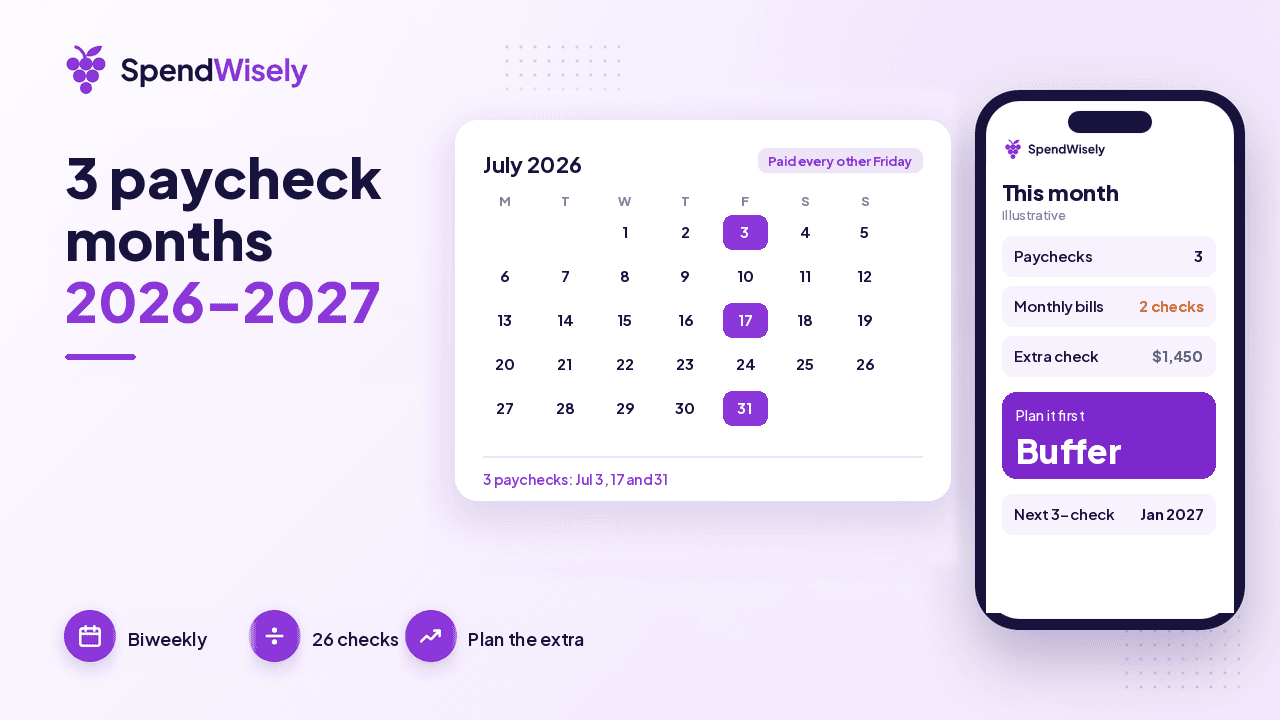
3 paycheck months in 2026 and 2027: dates and what to do with the extra check
Paid biweekly on Fridays? 3 paycheck months in 2026 and 2027 for both Friday schedules, why they happen, and what to do with the extra check.
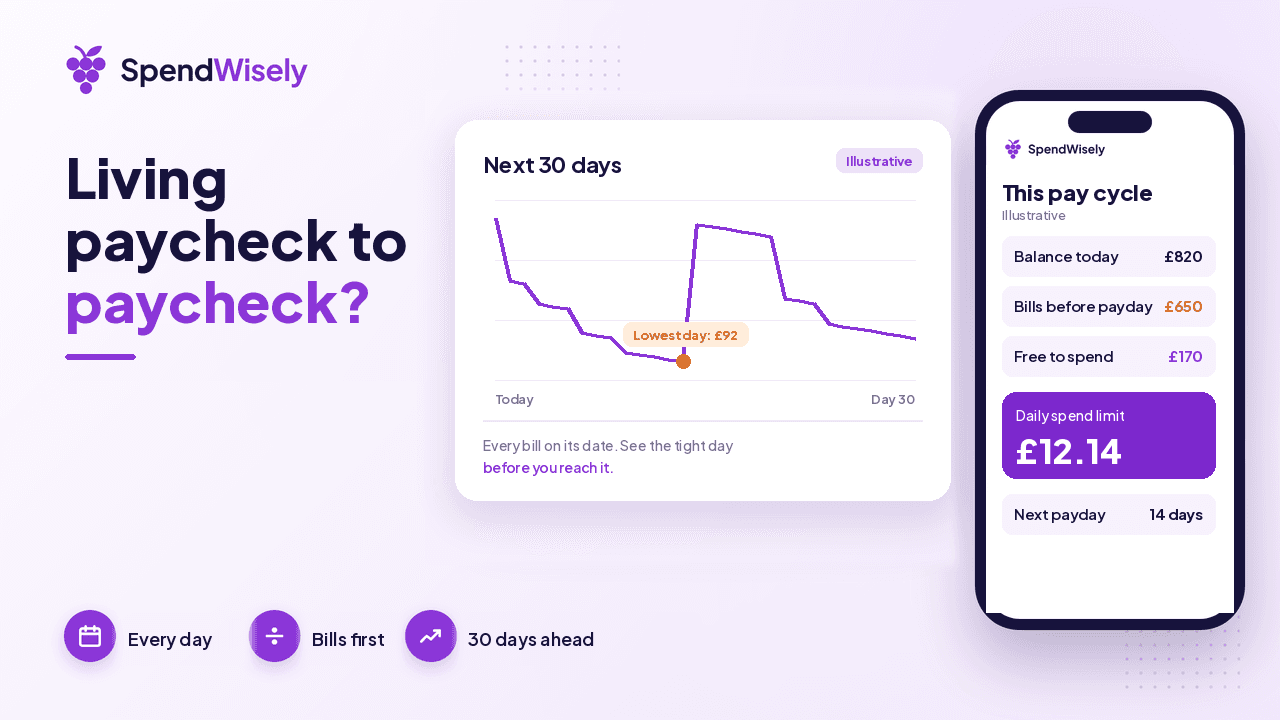
Living paycheck to paycheck: what it means and how to break the cycle
Living paycheck to paycheck means your pay runs out before the next one lands. The signs, why it happens on a decent wage, and how a 30-day forecast breaks the cycle.
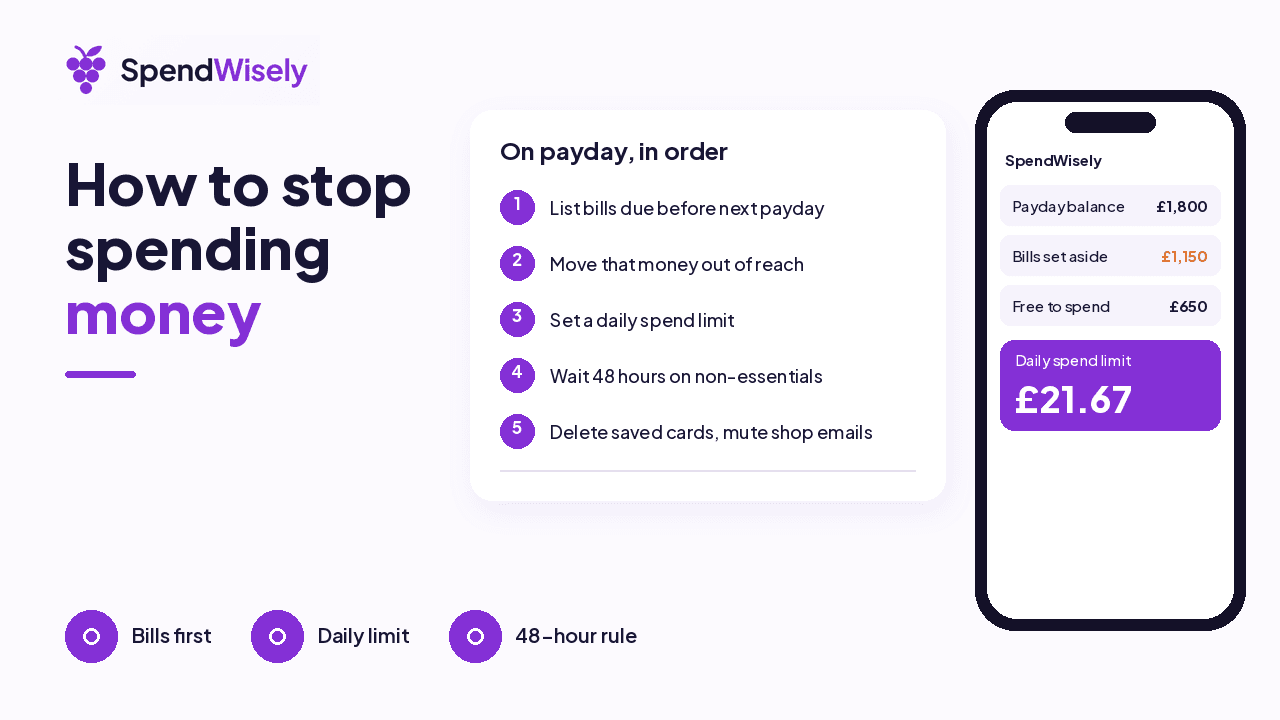
How to stop spending money: 9 steps that work between paydays
To stop spending money, move bills out on payday, set a daily spend limit, add a 48-hour pause and delete saved cards. Nine steps, no willpower needed.